
Conversations about awakening
The Therawake Podcast
My dramatherapy podcast: short, warm conversations about mental health, relationships and creativity with therapists and guests. Fourteen episodes, free to listen on Podbean and Spotify.

With Judy HarrisonHCPC-registered dramatherapist · HCPC AS14528
Listen to the dramatherapy podcast for free
The Therawake Podcast is an extension of my work: short, specialist conversations with therapists, practitioners and people with something to share about healing and “awakening”. The first series ran from May 2023 to January 2024 and has had more than 1,000 downloads. New episodes with new guests are on the way.
- 14 episodes + a welcome
- 4 to 37 minutes
- Free
- Hosted by Judy Harrison
Read the transcript
Hi, welcome to the Therawake Awakening Therapy Podcast. This is a new podcast, as an extension of the Therawake brand, where we will be inviting special guests to come in and speak about some amazing tips, stories, narratives around awakening. So they’ll be dropping some gems. They’ll be very short and punchy, but very specialist and very magical. And without further ado, welcome to the Therawake Podcast.
What is dramatherapy? In my words
In a May 2023 episode I talk with a newly qualified dramatherapist about creativity and finding your voice. In this clip I sum up something at the heart of dramatherapy: when words are hard to find, the body, drawing and play can speak instead, and nobody needs to be “an artist” to use them.
Read the transcript
What I love about what you’ve just said is we go back, like, full circle to the voice being a protest, the voice being an advocate. But what you said earlier on about the voice breaking the silence, so, you know, finding your authentic voice, and enabling the young people that you serve to find their authentic voice. Or, if they are voiceless at the time when you actually have them referred to you, that there’s other resources that you can use, i.e. their body, that probably they had no realisation they could use to express themselves. Or, oh, they might say, “Oh, I can’t, I’m not an artist”, or they’re a bit insecure about that. And you’re like, “No, just free draw.” It’s almost like just a freedom of expression which you allow.
Dramatherapy is an HCPC-regulated psychological therapy that uses role-play, storytelling, movement and creativity alongside talking. Read more about dramatherapy with me.
More clips, in my own words
Short moments from the series where I speak for myself. The full episodes are listed below.
Read the transcript
How do we turn that on its head to something positive? Journaling is a very good way and practice, because when we journal we’re speaking to parts of ourselves: parts of ourselves which are unhealed, and parts of ourselves which are healing, and parts of ourselves which are actually healed. So in our journaling we can always look back to see where we were along the way. And in journaling we get the opportunity to speak to the different parts, to soothe the different parts. Sometimes in the writing, in the journaling, the poetry comes, or the spoken word, or you may feel you want to sing, or you want to move your body, or you want to do an activity, or you want to have a soak in the bath, or you want to go to the sauna, or you want to go for a run. And then you find that you’re going from this hopeless state to now you are moving, because you’ve started moving the pen, right? You’ve started moving and creating this bilateral stimulation with the pen, and then you’re starting to move. And as you start moving, the body responds to that, because now you’re no longer in a kind of stop-start state. You’re in a state of: OK, I’ve stopped in that hopeless position, and now I’m going to move. So as you start to move, you start to feel better, you start to regulate, and then the hope, the window of hope, starts to open just a little bit. And then from there we’re ready to start the work, and continue to have that hope spark, spark, spark some more, until the flame appears and that warmth of hope reappears.
Read the transcript
Just to summarise, you know, our conversation today: the beauty of actually being in relationship with yourself. And the question I ask my clients a lot of the time is: if you weren’t yourself, would you want to be in relationship with you? Would you want to sit down and have a drink with you? Would you want to be an intimate partner with you? And, you know, if there’s like a pause, it’s like, OK, so that’s where we’re going to start. And that’s kind of when I came across the book, that’s what I was thinking about: the beauty of being with somebody who’s actually been able to develop the relationship with themselves, first and foremost.
Read the transcript
That emotional labour, fascinating. And it’s very British, isn’t it? Just to be very much masking what’s going on behind the face, and just kind of present to the world that everything’s OK, everything’s fine. You know, a classic is: “How are you?” “I’m good, how are you?” “Oh, I’m very well. Have a good day.” “You too.” And it’s almost like it’s a uniformed, rehearsed narrative exchange. But what do you think the fear is of actually not being OK? So somebody asking, maybe in school, maybe one teacher asking another teacher, or a member of SLT asking a teacher, “How are you today, Mrs Jones?” Mrs Jones says, “I’m not great.” What’s the feeling?
And two lines from the series that have stayed with me:
“Having that safe rock, that safety rock to keep you safe from going under, as a family, as an individual, as a community.”
Judy Harrison, “Black families and mental health”
“In order for things to grow, there has to be something that happens to the ground.”
Judy Harrison, “Grief and wellbeing”
All episodes
Newest first. Every episode opens on Podbean in a new tab.
-
Hopelessness to hope (opens Podbean in a new tab)
Solo episode
A short New Year piece for anyone who feels they have tried everything. I talk about the conversations we have with ourselves, journaling, movement and the first spark of hope.
Content note: Briefly mentions self-harm and substance use.
-
Moving Parts: a performance debrief (opens Podbean in a new tab)
Patricia Ojehonmon
A few days after performing a therapeutic theatre piece at a 2023 dramatherapy conference, Patricia and I step out of role together and talk about what the piece explored.
On this site: Theatre production dramatherapy
-
Racial trauma and therapy (opens Podbean in a new tab)
Olatunde Spence
An arts psychotherapist and EMDR therapist on racial trauma, and why naming race early on helps people feel safe in therapy.
On this site: EMDR therapy
-
Men’s mental health (opens Podbean in a new tab)
Rotimi Akinsete
Why many men find it hard to ask for help, the pressure to “man up”, and practical places to start looking for support.
Content note: Includes a conversation about suicide.
-
Black People Breathe (opens Podbean in a new tab)
Zee Clarke
The author of Black People Breathe on breathing with intention, and on noticing the stress we carry in our bodies.
Show the other 10 episodes
-
Talking about the menopause (opens Podbean in a new tab)
With a guest
Breaking the silence around the menopause: at work, in relationships, and in conversations that fit African Caribbean women’s experience.
-
Grief and wellbeing (opens Podbean in a new tab)
Albert, Vitavation
Grief beyond bereavement: losing a relationship, a dream or an old idea of yourself, and how communal rituals help people move through it.
-
Lived experience and recovery (opens Podbean in a new tab)
Jerome Sewell
A lived experience practitioner on recovery colleges, peer support, and services that help people grow rather than just “fix” them.
Content note: Discusses mental health crises, prison and violence.
-
Yoga, body and balance (opens Podbean in a new tab)
Ernestos, 7 Buddha’s
A yoga teacher on balance, posture and getting body and mind back in touch, and why one approach never suits everyone.
-
Black families and mental health (opens Podbean in a new tab)
Kenisha Jackson
A child and adolescent psychotherapist on trust, representation and early help, and why it can be hard for Black families to get support for their children.
-
Clinical supervision in schools (opens Podbean in a new tab)
Dr Julianne Mullen
Why school staff need a safe, confidential space to reflect, the signs of burnout, and how leaders can make it OK to say “I’m not fine”.
On this site: Clinical supervision
-
Life after dramatherapy training (opens Podbean in a new tab)
Kathleen Charles
A newly qualified dramatherapist, poet and spoken word artist on creativity, finding your voice, and the idea that everybody is creative.
On this site: Dramatherapy
-
The Magic In Me (opens Podbean in a new tab)
Dr Rina Bajaj
A counselling psychologist on the most important relationship of all, the one with yourself, and what change feels like from the inside.
On this site: Couples counselling
-
The narcissist and the perfect victim (opens Podbean in a new tab)
Keeley Taverner, Key 4 Change
Caring people who give without limits in one-sided relationships, and what changes when the giver starts to set boundaries and protect their heart.
Content note: Talks about emotionally abusive relationships.
On this site: Couples counselling
-
Welcome to the Therawake Podcast (opens Podbean in a new tab)
Solo episode
The 40-second welcome that opened the series.
Guests’ views are their own. The podcast is for listening and reflection, not therapy or medical advice. If anything here brings up difficult feelings, the support lines below are there day and night.
From my video conversations
Read the transcript
[Abi Osho] My earliest memories back then, when I was probably around four and a half years old, getting on a bus with my foster mum, was of this old, elderly white couple wiping the seat, and me hearing that, you know, coloured people are dirty, so you’ve got to wipe the seat clean before you can sit down. So in a four-year-old’s mind, you know, there’s no distinction, so I took this to be truth. So I always saw, literally, that I was dirty. I would try and scrub the colour of my skin away. Obviously it wouldn’t come away. So all of those things over those years. Those were very racist times.
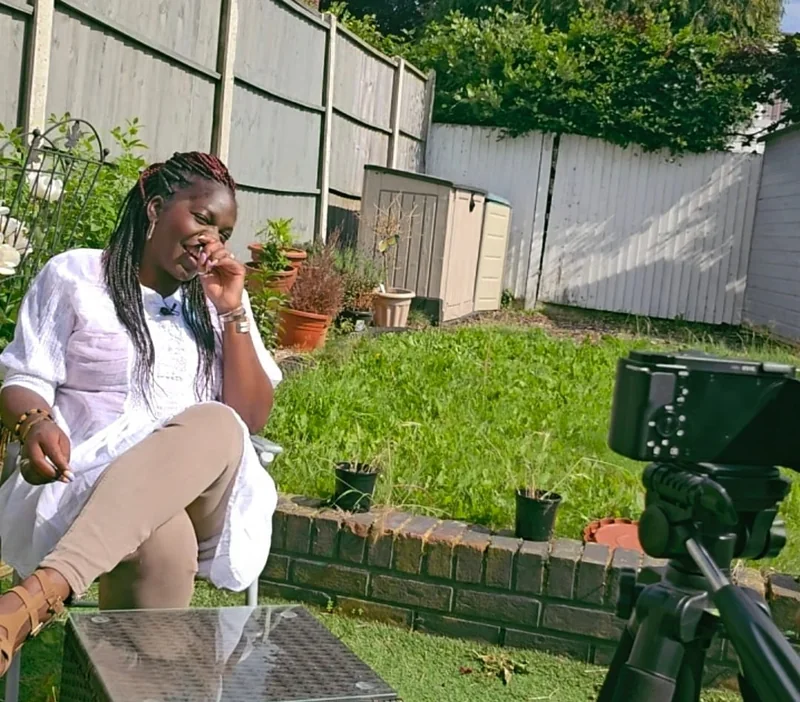
Some of my newer conversations are recorded on video and shared on my social media. In this clip, my guest Abi Osho remembers the first time she met racism as a small child, and how a four-year-old makes sense of it.
Content note: describes racism experienced as a child.
Suggest a topic
Is there something you would like to hear me talk about, or would you like to be a guest? Email me with a few lines about the topic and why it matters to you.
The first step
How to start
Book a time that suits you
Choose a slot online in a couple of minutes, or email me if you would rather ask a question first.
Talk it through
We talk about your reasons for seeking support, your hopes, and any questions about how therapy works.
Decide, with no pressure
If it feels right, we agree the approach that suits you. If not, that’s completely fine too.
Questions
Questions about the podcast
Can’t see your question? Read all the FAQs, email admin@therawake.co.uk or see other ways to get in touch.
Where can I listen to the Therawake Podcast?
Are there new episodes coming?
Yes. The first series ran from May 2023 to January 2024, and more is on the way: I am recording with new guests over the Christmas season. New episodes will be shared on my social media and YouTube, so follow me there to hear them first.
Is the podcast the same as therapy?
No. The podcast is for listening and reflection. It is not therapy and not medical advice, and guests’ views are their own. If you would like support for yourself, start with a confidential first consultation.
Can I suggest a topic or be a guest?
Yes, I’m always happy to hear ideas and offers to be a guest. Email me with a few lines about the topic, or about you, and why it matters to you.
Need help right now? Therawake is not an emergency service. If you or someone else is in immediate danger, call 999. For urgent mental health support, call NHS 111 (option 2), or talk to Samaritans any time, free:
Call Samaritans 116 123
Ready to take the first step?
You’ve already done something brave by looking. Book a confidential 30-minute first consultation (£25), or send me an email with any questions.